If you sell medical equipment, the hardest part of the sale happens before anyone signs anything. It’s the moment the buyer tries to picture whether the equipment will actually fit and can’t. That single question stalls more deals than price ever does.
Left unanswered, it does real damage: the proposal drags on, the buyer hesitates, and the deal quietly dies.
This is the story of a medical equipment distributor that removed that friction entirely. They replaced static documents and manual quoting with a single interactive system a custom 3D product configurator that lets their team plan a room, validate equipment placement, and generate a client-ready quotation in one workflow.
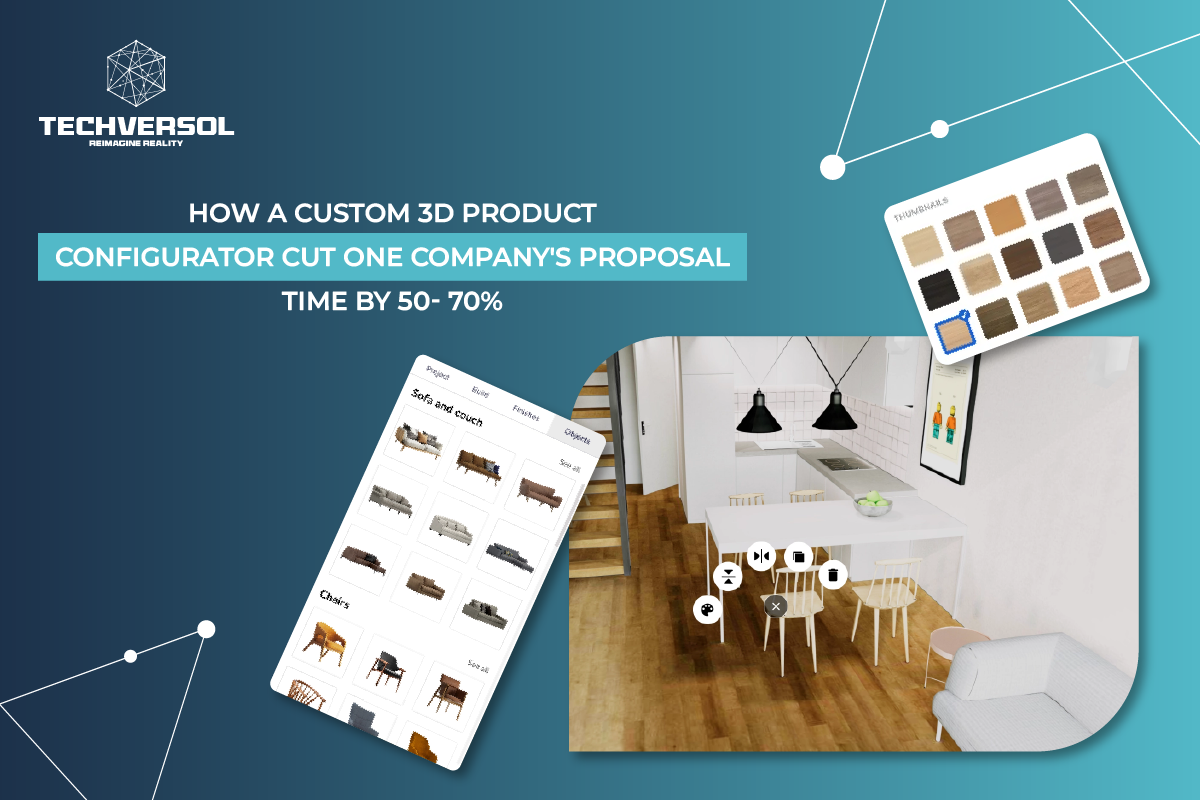
The result wasn’t just a better-looking proposal. It was a measurable shift in how fast and how confidently they could sell: proposal turnaround dropped by 50-70%, layout errors fell sharply, and adoption was high enough across the sales team and hospital users that the tool changed how the company operated day to day.
Here’s how it came together and how the same approach can work across the medical equipment industry.

See What Your Configurator Would Take to Build.
Book a 30-minute scoping call and walk away with a fixed shape for your project scope, timeline, and a clear first version. No per-seat fees, no commitment to build. Just a straight answer on what it takes.
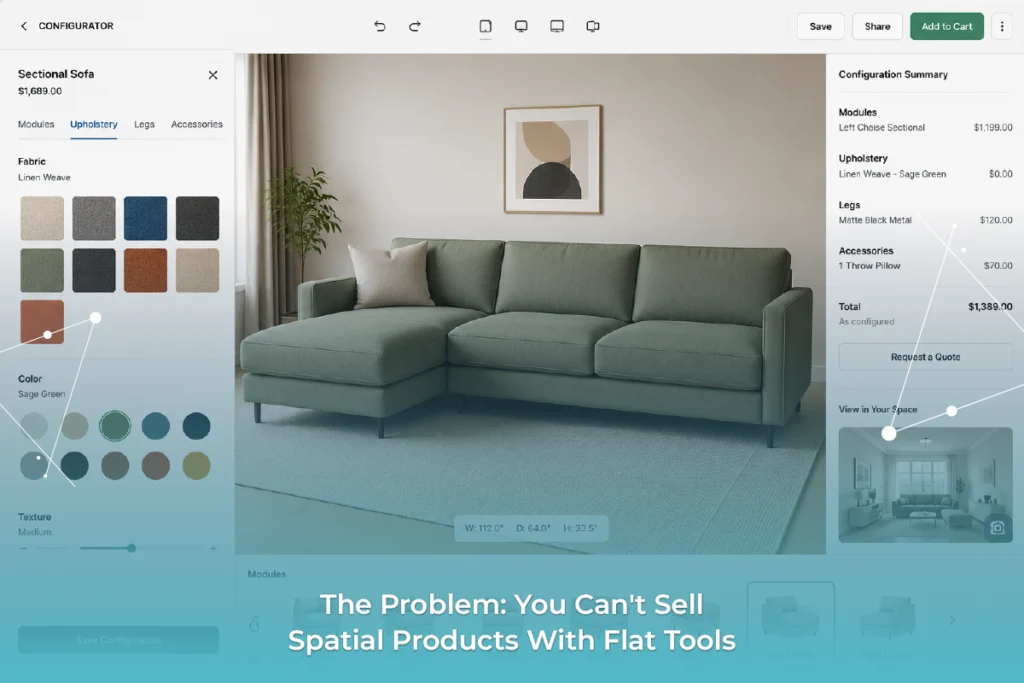
The Problem: You Can’t Sell Spatial Products With Flat Tools
Our client was a US-based medical equipment distributor sitting between equipment manufacturers and hospitals. They sourced the specialized medical equipment and helped healthcare facilities plan, position, and install it inside real, dimension-constrained rooms.
The problem with that was the toolkit: their planning used to run on static documents, 2D rough images, and quotations assembled by hand. Although the tools suggested where the equipment should sit, they couldn’t answer the questions that helped buyers close the deal.
- How much usable space does the room really have?
- Do articulated pieces the ones that pivot, rotate, and extend collide with anything around them?
- Do the selected products fit within the room’s true dimensions and clearance?
- How quickly can the sales team turn a rough room concept into a polished, accurate proposal?
Leaving these questions blank added risk and delay; the proposal took too long, and the layout mistakes slipped through and needed to be cut on the site. The hospital stakeholders had a hard time approving plans as they couldn’t clearly see the equipment well established. So, for a business whose entire edge depended on moving from interest to signed proposal, the gap costs so much.
The Goal: One Tool That Plans and Sells
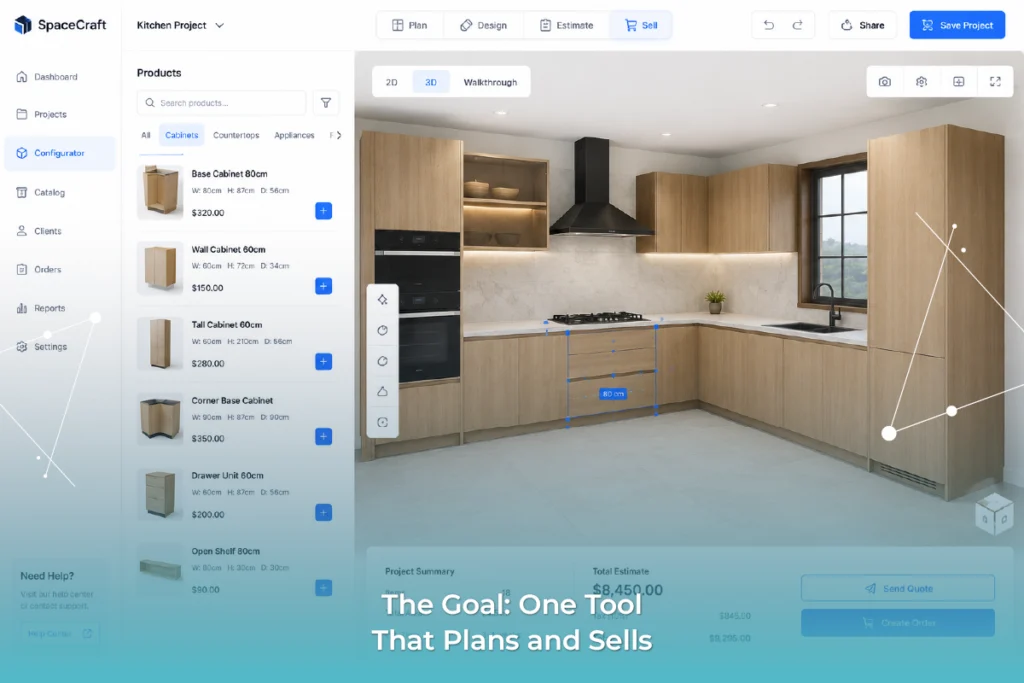
Their brief was ambitious; the client didn’t want any visualization gimmick bolted into the existing process. They wanted a single enterprise desktop application that did two jobs at once, and that was none other than Medical Equipment Configurator.
A Planning Engine
You can let the team and selected end users configure the rooms visually in 3D, and then validate spacing, clearance and movement against the real-world constraints.
A Sales Enablement Tool
You can turn these validated layouts into the quotation documents that carry the technical details and commercial terms ready to send.
What We Built
Techversol designed and engineered a custom 3D product configurator from the ground up, as it’s not a template but a product shaped around clients’ actual business processes, built on a reusable foundation ready for future white labels and multi-client expansion.
Users can assemble a room from the library of configurable equipment to supporting components, review it in an interactive 3D scene, and export complete proposals in one minute. The core capabilities include:
Interactive 3D Room Planning
They can drag and drop placement, snapping, room dimension handling, and synced 2D and 3D views.
Constraint-Aware Equipment Behavior
Medical products are not static, with system model rotation, extension, collision check and equipment toequipment rules. With proximity validation and blocking unrealistic configurations before they reach a client.
Orbit, Pan, And Zoom Camera Controls
The enterprise-grade offering controls live camera review during approvals and presentations.
Sales-Ready Quotation Generation
The automated PDF output with equipment lists, pricing, 2D layouts, room dimensions, 3D previews and all in one client-facing format.
The last capability is easy to skim, but it can be the heart of the whole story. online product configurator doesn’t have to stop at layout; it carries the work all the way through to the document that can win the deal.
The Results
Once the tool is in the hands of the internal team and selected hospital users, the numbers moved in exactly the direction a sales organization needs. What matters the most isn’t the percentage on its own, but the mechanism behind every one of them.
| What changed | Result | Why It Moved |
| Proposal turnaround time | Down 50–70% | Layout and quotation now happen in one workflow instead of three separate tools |
| Layout errors | Down ~40% | Collision detection and clearance validation catch conflicts before a plan ship |
| Quotation generation | ~95% automated | Pricing, quantities, and layouts flow straight from the validated 3D scene into the PDF |
| Team & client adoption | High across the board | Internal staff, hospital teams, and end users all configured rooms independently |
A few of these compounds on each other which is where the real value lives.
Want To Cut Your Proposal Turnaround By 50–70%?
That’s what a custom 3D configurator did for one medical equipment distributor. Tell us your product logic and room rules we’ll show you how the same system fits your sales process. Start with a free scoping call.
Faster Proposals Mean More Proposals
Cutting proposal time doesn’t only save hours, but it shortens the sales cycle and frees the team to help them chase more opportunities in the same week. Speed at the proposal stage is a direct lever on revenue.
Visual Clarity Builds Buyer Confidence
When hospital stakeholders see a true-to-scale 3D layout instead of squinting at the 2D sketch, they stop hesitating. Buyers can approve faster when they see precisely what they are getting, and only a few plans can bounce back for “can you show me what this can look like”
Catching Errors Early Protects Your Margin
Collision detection and clearance validation cut layout errors by 40%; this means only a few reworked plans, few costly on-site surprises and few renegotiated quotes.
High Adoption Is What Made It Real.
None of this can matter if the tools are unused. So, instead of internal staff, end users configured rooms and end users independently. Adoption is what turns a piece of software into a genuine change in how a business sells.
Why This Works Far Beyond Medical Equipment
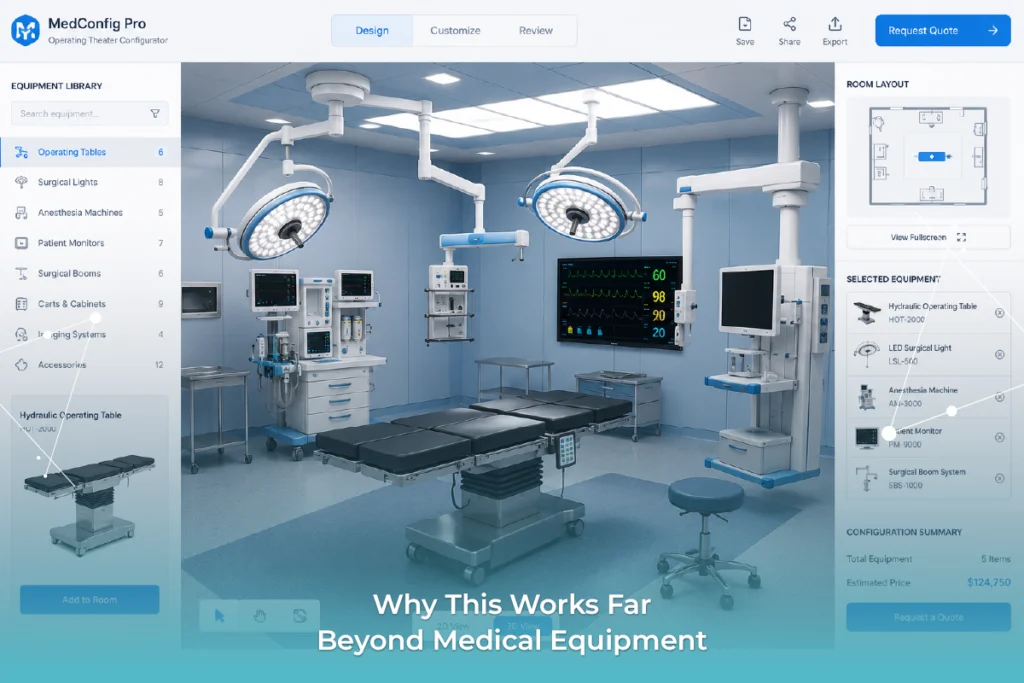
Mechanics are specific to medical rooms, but the pattern may apply to any business that’s selling products but is spatially constrained, complex and coupled to the same sales process, including,
- Healthcare and lab solution provider.
- Furniture, equipment (FF&E) supplier.
- Industrial system and manufacturer.
- Engineering and fit-out firms.
Whenever a buyer needs to understand the fit, layout, and price before they commit, an interactive 3D product configurator can collapse what once used to be a multi-week, multi-tool process into a single visual conversation.
The system is built on a reusable foundation; the same core can extend to a WebGL browser-based online product configurator, a server-backed multi-user platform and subscription tooling, with a catalogue-driven interactive marketing experience. What starts as a planning tool can grow into a full digital sales product.
What It Takes to Build One
The most common question that comes to mind isn’t “does this work”? But it’s what would it take for us? And here’s an honest shape of that build.
It Starts with Your Product Logic, Not Graphics
The hard and most valuable part isn’t the 3D scene but encoding the real-world rules that your products obey, like dimensions, clearances, and what can sit next to what, and how every piece that is articulated moves. If your team knows the rules, we can also model them.
It’s Built ona Reusable Core
We build a foundation from scratch every time, such as a focused first version, a defined product library, and room planning; validation and quotation export can be a matter of weeks, not quarters. This way, the scope drives more timeline than technology.
It Grows with You
A desktop planning tool can become a browser-based interactive product configurator for the website, a multi-user platform, or even a self-serve experience for buyers. Start focused; keep the first version fast to ship it without boxing into what comes next.
It’s Yours to Own
This isn’t a per-seat SaaS subscription that you rent forever. It’s a custom system built around the catalog, your sales process and pricing.
The Takeaway
It can be tempting to file a 3D product configurator, that too under a visualization feature, as this undersells it. The commercial system connects product complexity to commercial clarity, shortening the path from interest to quotation and cutting the planning and pricing work. This sharpens the client presentation, turning a static catalog in an interactive decision-making tool.
For this medical equipment provider, it meant faster sales, confident buyers, fewer mistakes, and a team that has adopted tools wholeheartedly. The buying experience doesn’t start at contracts, but it starts at the moment customers can finally see what they are buying.
Own Your Configurator, Don’t Rent It Forever
No SaaS subscription, no per-seat pricing. A custom system built around your catalog, your pricing, and your sales process. Book a scoping call and see how fast a focused first version can ship.