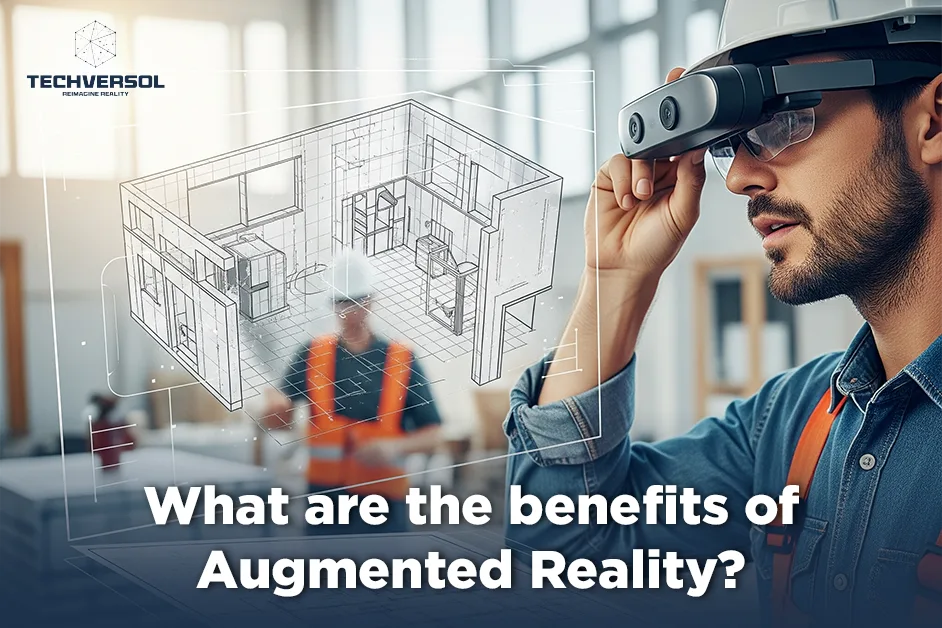
A transformative technology that integrates digital elements with the real world, Augmented Reality (AR) improves users’ perception of reality. Techversol’s augmented reality services overlay digital information on the real world unlike virtual reality (AR) which engages users in a digital environment. This worthwhile difference in augmented reality services allows AR to offer numerous practical benefits across different domains such as industry, entertainment, education, healthcare, and retail. Techversol, in this article, will let you explore what does augmented reality means, and the benefits of augmented reality services, and illustrate how augmented reality works.
What does Augmented Reality mean?
Augmented Reality has a basis of overlaying digital information onto the physical world by enhancing your reality perception by adding digital content layers, including data, sounds, or images, on top of the view of the real-world environment. It commonly uses sensors, cameras, and displays to combine digital elements effectively with the physical world.
Benefits of Augmented Reality (AR):
Enhanced Education:
The most noteworthy benefit of augmented reality services is it enhance learning and education. The approaches of traditional learning usually lean heavily on static visuals and textbooks, which can be limiting. Techversol‘s augmented reality services offer an interactive element to education which makes education and learning more engaging and effective for learners or students. In addition, AR applications can bring intricate ideas to life. In a biology class, for example, students can use our augmented reality services to explore the 3D model of their subject or a human body, examining systems and organs from various angles.
Furthermore,augmented reality services can transform learning into an experience of game-like, increasing participation and motivation. These games can interactively present challenges and rewards, making learning more enjoyable. Moreover, in real-world context augmented reality services can effectively place educational content in the contexts of the real world. History students, for example, can explore historical events or landmarks via AR to achieve an in-depth knowledge of historical significance and contexts.
Revolutionize Healthcare:
Augmented reality’s impact on healthcare is deep and provides effective solutions that enhance, surgery, diagnostics, and patient care. Surgical precision is one example, the surgeon, by using our augmented reality services, can overlay essential information, such as 3D images of organs or tumor locations, onto the body of their patient during operations, allowing them to reduce any risk and improve accuracy. In addition to that,augmented reality services offer medical students simulated experiences, mimicking scenarios of real life. This technique can be essential for understanding anatomy and mastering complex procedures.
Don’t forget our augmented reality services can assist patients with comprehending their treatments and conditions by intuitively visualizing the progression of diseases, improving patient compliance, and alleviating anxiety.
Transforming Retail and E-Commerce:
AR, in retail, is transforming how customers make decisions for purchasing and interact with products. Augmented reality services allow customers to try on makeup, accessories, or even clothes virtually, reducing the need for try-ons physically and helping customers to make better choices. In fact, nowretailers can create interactive experiences in-store by using augmented reality services. AR apps, for instance, offer additional product or promotional information when customers scan items with their smartphones.
Advancing Manufacturing and Industry:
Augmented reality is making influential strides in different industrial applications, enhancing safety, efficiency, and training. Augmented reality services can overlay each instruction or schematic onto machinery, guiding technicians through complex repairs, and reducing the likelihood of errors. In addition, AR simulations offer hands-on training for employees which allows them to practice skills in a risk-free environment, valuable for training in unsafe or complex fields. On the other hand,our augmented reality services help in the process of design by allowing designers and engineers to visualize prototypes in physical world settings.
Enhancing Entertainment and Media:
The entertainment industry has assumed augmented reality to create interactive and immersive experiences. AR games like Pokémon GO, integrate digital elements with the physical world, making interactive and engaging experiences. The players of this game can explore real-world environments while interacting with virtual objects and characters. Moreover, Augmented reality services can effectively enhance storytelling by combining digital content with physical environments. Augmented reality, for instance, brings movies or books into reality by allowing users to interact with elements and characters from the story in their surroundings. AR is being utilized to augment live events or performances. AR, for example, can create visual effects or offer additional information about performances and performers.
Enhancing Navigation and Travel:
Augmented reality services can effectively improve travel and navigation experiences by offering real-time guidance and information. AR can overlay valuable information, points of interest, or directional arrows onto an entertainment’s live view. This is valuable for drivers and pedestrians’ alike, providing guidance that improves convenience and safety.
In addition,Augmented reality services can improve the travel experience by offering virtual guides, translations, or historical information in real-time. Tourists can explore cultural sites with interactive elements by using AR apps. AR can assist users with navigation to destinations in large venues, such as shopping malls or airports, by offering location-based information and real-time directions.
Workplace Efficiency:
Augmented reality, in the workplace, is driving innovation and efficiency in several areas.
AR allows collaboration remotely with allows team members to interact with digital information and 3D models in real-time, regardless of their physical location. In fact, AR apps can overlay valuable information onto work environments such as instructions or display data directly on work surfaces or machinery. Augmented reality services offer real-time hazard alerts and safety training in industrial environments, enhancing workplace safety.

Techversol’s Augmented Reality Services:
Custom AR App Development:
Design and develop tailored AR applications for mobile, tablet, or wearable devices, effectively suited to specific business requirements. Focus on user-friendly interfaces and smooth integration with existing systems.
AR Content Creation:
Create high-quality, interactive 3D models, animations, and visual assets for AR experiences. Build immersive content that improves product demonstrations, training, and customer engagement.
AR Solutions for E-Commerce:
Implement AR features for virtual product try-ons, virtual store tours, and interactive product displays to improve the online shopping experience. Enhance customer engagement and drive sales through AR-powered product visualization tools.
AR Integration with Marketing Campaigns:
Create AR experiences that incorporate digital marketing approaches to boost brand engagement. Make interactive ads, AR games, and branded experiences to drive customer interaction and boost brand recognition.
AR for Training and Education:
Develop AR-based training modules for businesses and educational institutions, providing immersive learning experiences. Design hands-on simulations for complex tasks, product assembly, or operational training.
AR for Real Estate:
Develop AR tools for virtual property tours, letting clients visualize spaces remotely. Blend AR with architectural designs to offer potential buyers a more lifelike sense of a property’s layout and features.
AR in Healthcare:
Create AR solutions for medical training, surgery simulations, and improved patient education. Develop AR-based tools for medical imaging and diagnostics to assist healthcare professionals.
AR for Event Engagement:
Design AR experiences for events, conferences, and trade shows, improving attendee engagement with interactive elements such as virtual product displays or AR games. Create custom AR apps that allow users to interact with the event content or location in real-time.
Location-Based AR:
Create location-based AR applications that employ GPS and real-time data to overlay information on physical environments. Utilize AR for guided tours, navigation, or gamified experiences at landmarks or public events.
AR Maintenance and Repair Solutions:
Design AR tools that help technicians with on-site maintenance, offering step-by-step instructions and visual overlays to simplify repairs. Offer AR-based solutions for equipment troubleshooting, lessening downtime, and boosting efficiency.
AR for Manufacturing and Production:
Design AR applications that improve the manufacturing process through real data visualization, assembly guidance, and workflow optimization. Implement AR for remote support, letting experts offer live assistance to on-site workers.
AR Game Development:
Create immersive AR games that integrate the physical and digital worlds, providing interactive and engaging experiences. Build AR games for entertainment, marketing campaigns, and customer engagement.
AR Analytics and Insights:
Implement AR-driven analytics solutions to track user interactions and collect useful insights from AR experiences. Calculate engagement and optimize AR content based on data-driven results.
AR Consulting and Strategy:
Provide consulting services to allow businesses to identify how AR can improve their processes, customer engagement, or product offerings. Create a wide AR approach tailored to your business objectives and goals.
Cross-Platform AR Solutions:
Offer cross-platform AR solutions that work seamlessly across various devices, assuring wider accessibility and reach.

Why to Choose Techversol’s Augmented Reality services:
- Tailored AR Solutions: Custom AR experiences designed for your business requirements and objectives.
- Industry Expertise: Proven track record in sectors such as healthcare, real estate, e-commerce, education, and manufacturing.
- Cutting-Edge Technology: Utilizing the latest AR tools and technologies to offer immersive, high-quality experiences.
- End-to-End Services: Full range of augmented reality services from strategy, design, and development to deployment and support.
- Proven Success: A history of delivering AR solutions that improve customer experiences, boost sales and streamline operations.
- Dedicated Support: Ongoing consultation and technical support to help you maximize the value of your AR investment.
- Cutting-Edge User Experiences: Developing intuitive and real-world useful AR interactions employing cutting-edge technologies.
- Adaptable to Trends: Always stay ahead with the latest AR innovations to keep your business competitive.
Benefits of Choosing Techversol’s Augmented Reality Services:
| Factor | Techversol | Other Companies |
| Tailored Solutions | Custom AR experiences designed particularly for your business. | Generic AR solutions are often not personalized. |
| Expertise | Vast experience across industries such as healthcare, real estate, e-commerce, and more. | Limited experience or focus on only one or two industries. |
| Advanced Technology | Utilization of the latest AR technology, tools, and platforms. | Use of outdated AR technology or basic AR features. |
| Scalable and Flexible | Scalable AR solutions that grow with your business, no matter the size. | Rigid solutions that may not scale to meet evolving requirements. |
| Innovation and Trend Adaptability | Always stay ahead with the latest AR trends, tools, and features to ensure your business stays competitive. | Slow to adopt new trends or technologies in AR. |
What is Impact of AR in Marketing?
Enhanced Customer Experience:
Augmented Reality (AR) is revolutionizing the way customers interact with products by offering features like virtual product try-ons and real-time product visualization. Virtual try-ons allow customers to experience products, such as clothing, makeup, or accessories, in a personalized way before making a purchase, enhancing their confidence in buying decisions. Real-time product visualization lets users see how items, like furniture or home decor, would look in their own space, creating a more immersive and satisfying shopping experience.
Improved Engagement:
AR technology helps brands create interactive experiences such as games, scavenger hunts, and other engaging activities that encourage deeper interaction with the brand. These experiences not only entertain but also foster customer loyalty and long-term engagement. Additionally, AR can bring traditional marketing tools, such as print ads and billboards, to life by embedding interactive elements like 3D models, videos, or additional information, creating a memorable and dynamic interaction with the brand.
Social Media Integration:
Platforms like Instagram and Snapchat leverage AR features like filters and lenses, allowing users to engage with brands in creative and interactive ways. These AR experiences can be shared across social networks, increasing brand visibility and interaction. Furthermore, influencer collaborations that incorporate AR into content creation can enhance brand appeal, offering an innovative way for influencers to promote products while maintaining authenticity and audience engagement.
Cost-Effective Marketing:
AR significantly reduces the need for physical prototypes, photoshoots, and large-scale events, offering a more efficient way to showcase products and services. With virtual product demos and experiences, brands can reach a broader audience without the logistical and financial burdens of traditional marketing tactics. This makes AR a highly cost-effective tool for engaging customers on a global scale while streamlining marketing operations.

Common examples of Augmented Reality and Virtual Reality:
Augmented reality entails abundant and growing use cases. Here are some basic applications you can engage with now.
- Ikea Place, a mobile app, lets you visualize Ikea furniture in your home, by overlaying a 3D representation of the piece atop a live video stream of your room.
- YouCam Makeup allows users to virtually try on real cosmetics through a live selfie.
- Repair technicians can don a headset that walks them via the steps of maintaining or fixing a broken piece of equipment, diagramming precisely where each part goes and the order in which to do things.
- Different sports depend on AR to offer real-life statistics and enhance physical training for athletes.
Some business examples, beyond gaming and other entertainment cases, of virtual reality include:
- Architects are employing Virtual Reality to design homes and let clients “walk through” before the foundation has ever been laid.
- Automobiles and other vehicles are increasingly being designed in VR.
- Firefighters, soldiers, and other workers in dangerous environments are employing VR to prepare without putting themselves at hazard.
What is AR Vs VR?
| Feature | Augmented Reality (AR) | Virtual Reality (VR) |
| Definition | Overlays digital content on the physical world. | Makes a completely immersive, virtual environment. |
| User Experience | Interaction with the physical world and digital components simultaneously. | Fully immersive experience with no interaction with the real-life world. |
| Technology | Utilizes cameras, sensors, and displays to incorporate digital and real-life worlds. | Employ VR headsets, motion controllers, and sensors to build a virtual environment. |
| Purpose | Improves the real-life world with digital information. | Offers a fully simulated environment separate from the physical world. |
What Devices Uses AR and VR?
Devices Uses AR:
- AR HEADSETS
- AR PROJECTORS
- AR GLASSES
- AR TABLETS
- AR SMARTPHONES
Devices Uses VR:
- VR HEADSETS
- VR CONTROLLERS
- VR Full Body Tracking System

Bring Your Vision to Life with Augmented Reality
Final Thoughts:
Augmented reality’s future holds tremendous potential across different industries, with its capability to seamlessly incorporate the digital world with a life-like environment. AR is envisioned to become more immersive, intuitive, and integrated into daily life as technology continues to evolve. AR devices in the next years are likely to become more lightweight, comfortable, and developed, letting users access real-time information, navigation, and virtual components without the demand for smartphones or bulky equipment.
FAQs:
1- Is augmented reality an AI?
Augmented reality overlays digital content in the real world that can be viewed via headsets or mobile devices. However, AR cannot be separated from AI as it needs AI to function.
2- What are the key differences between AI and AR?
Artificial intelligence (AI) develops intelligent systems that can reason, understand, and act independently. Augmented reality (AR) is a technology that lets users superimpose digital content onto the real world.
3- What is AR 3D model?
A three-dimensional AR model means virtually placing a realistic, 3D item into the customer’s physical world environment.
4- What is meant by VR?
Virtual Reality (VR) is a computer-generated environment with scenes and objects that seem to be real, making the user feel they are engaged in their surroundings.
5- What are AR apps?
An AR app is a software application that incorporates digital visual content into the user’s physical world environment.